This slideshow requires JavaScript.
Gretas Herbs Annascaul, Dingle, Co Kerry
Potted herbs – Gardening Classes
-
-

The long awaited summer blissfully swept by and now autumn sadly is fast approaching. Most plants thrived in the garden if kept adequately watered during the dry period. Recent chores include dead heading and weeding. Continue liquid feeding tomatoes, courgettes, salad plants and most other kitchen garden crops. Once the temperature begins decreasing around September stop feeding everything outside. Anything indoors may be fed until active growth ceases later that month.
To ensure some edible produce for the winter month’s make late sowings of rocket, lettuce and salad herbs such as Mizuna and Red Mustard Greens over the coming weeks. Many of these oriental herbs are very hardy, tolerating cool temperatures and yielding a generous supply through the winter. They dislike high temperatures so unfortunately many bolted this summer. Basil may still be grown on a sunny windowsill and should continue until late September and even into October. Careful watering early in the day is essential and always harvest from the tips, this encourages further bushy growth.
I like to remove all dead flower heads of herbs such as Fennel and St John’s Wort before they set seed otherwise they will take over your garden and become an unwelcome weed. In Autumn I usually prune back by approximately a third leaving some bulk to protect them through the winter, then next spring it is machete time and everything gets cut back to ground level.
The main planting season is over but great bargains can now be captured when purchasing perennial (grows for many years) herbs and other plant varieties. They may appear scraggy in the pots due to hunger so plant out or pot on. If they have a well developed root system they should grow vigorously next spring. Remember Thymes are best retained in sandy soil in pots throughout the winter and planted out next year, ideally into a raised bed or larger container. Mints must be restrained, but unlike Thymes prefer a rich, moist soil. Indeed my flowering treasure this year turned out to be a massive almost jet black hollyhock. It was the weakest of the mixed batch I sowed last year. I half heartedly planted it late last autumn, forgetting all about its existence until it demanded my attention with a bold statement this year. It then got its fair share of T.L.C. and its stunning stems of black beauty rewarded me with weeks of pleasure.
-
-
GRETA’S HERBS: MINT

Mentha species; this fantastic group of herbs belong to the extensive Labiatae or Lamiaceae family. Some of its relatives include Lavender, Basil, Lemon Balm and Oreganos, all with extremely pungent flavours but none as persistent and diverse as their mint cousins. There are hundreds of varieties which are often difficult to identify as mints interbreed readily. Usually the best way is by simply smelling but even that can be confusing at times. Their origins tend to come from all corners of the globe and mint is used abundantly in worldwide cuisines. It gets plenty of mention in Greek and Roman mythology and there are also biblical references. It has been regarded as a symbol of hospitality and adornment by many cultures and its many uses range from deterring insects to scenting our bath water. I recently enjoyed reading this reference to Mint ‘Eau de Cologne; ‘I live on a farm with pigs etc., which attract a great number of flies and wasps. Since buying the Eau de Cologne plants they have grown and spread out. I just pinch and rub the leaves to release scent and wait. The flies and wasps after a while get a drunk effect and then drop down dead, truly amazing, seeing is believing.’
Mentha spicata which is spearmint is the main variety for mint sauce. It is also the mint used in mojitos, toothpaste and confectionery. Strangely enough Mentha aquatica (watermint) which grows happily in my pond is a parent of many varieties and a cross between it and Mentha spicata created the wonderful hybrid Mentha x piperita (peppermint). Again this variety exudes a glorious aroma and flavour which makes it ideal for desserts and teas. The chocolate variety of this is M. piperita f. citrate which excites everyone especially children. All mints love rich, moist soil in partial shade and are ideal in our climate. They need to be restrained as their underground rhizomes spread everywhere and it can become a proper nuisance. Either grow it in containers or line your planting hole with a sheet of thick polythene, slightly pierced to prevent water logging. Mentha suaveolens (Woolly or Applemint) is a very decorative variety and has lovely pale, mauve flowers which attract bees and butterflies. There is also a variegated version and again a host of relatives, my latest addition is ‘Grapefruit mint’.
When discussing the mint clan we must not forget one of its major contributions to chemistry which is ‘Menthol’. This organic compound is derived from peppermint and other mint oils. It has an incredible array of uses, especially in dental products such as mouth wash hence giving that cool, refreshing sensation which is also slightly anaesthetic. It can also be used in a marvelous array of cosmetics and toiletries even though I suspect modern science now allows artificial compounds to dominate.
-
Greta’s Herbs: Coriander

Coriandrum is the genus and sativum the species. It belongs to the Apiacea family which also includes Parsley and Celery and so is also referred to as Chinese Parsley. The latin word sativum means cultivated. There are lots of plants with this attachment to their name, often determining their edibility e.g. Crocus sativus (Saffron), Ribes sativus (Red currant) and the more controversial Cannabis sativa.
The entire Coriander plant may be utilized in cooking. The flavour is powerful and many people find it nauseating but I like it a lot, even in salads. It is important to make a distinction between the herb Coriander and the spice Coriander. The leaves are often called Cliantro but this is merely the Spanish translation for Coriander even though the variety I grow for its foliage is called ‘Cliantro’. The seeds when dried and crushed are the spice which is used worldwide especially in Indian cooking. I have collected and ground some in recent years however I am resigned to the fact that the Irish summer cannot give this spice that alluring Indian flair. In this damp climate the leaves are a more reliable source of flavour. It is also a vital herb in Mexican salsas and guacamole so has a wide spectrum of cuisine uses.
It is quite easy to grow from seed in a poly-tunnel or on your windowsill from Feb to end May. It is also much hardier than one would imagine and can be planted outside from April on, either in the ground or in containers but requires a sunny position. It will bolt too quickly if it does not get plenty of feeding and watering so lavish it with attention and you will be rewarded. Cut frequently to encourage more foliage and store leaves in a plastic container in your fridge just like parsley or freeze in ice cubes if you have large quantities.
Coriander, like many spices, contains antioxidants which can delay or prevent the spoilage of food seasoned with this spice. A study found both the leaves and seed to contain antioxidants, but the leaves were found to have a stronger effect. It has many medicinal qualities and has been used as a folk medicine for the relief of anxiety and insomnia in Iran. It can however produce an allergic reaction in some people, so if you feel repulsed by the flavour, take heed, you may be one of the unlucky ones!
-
-
GRETA’S SALAD HERBS

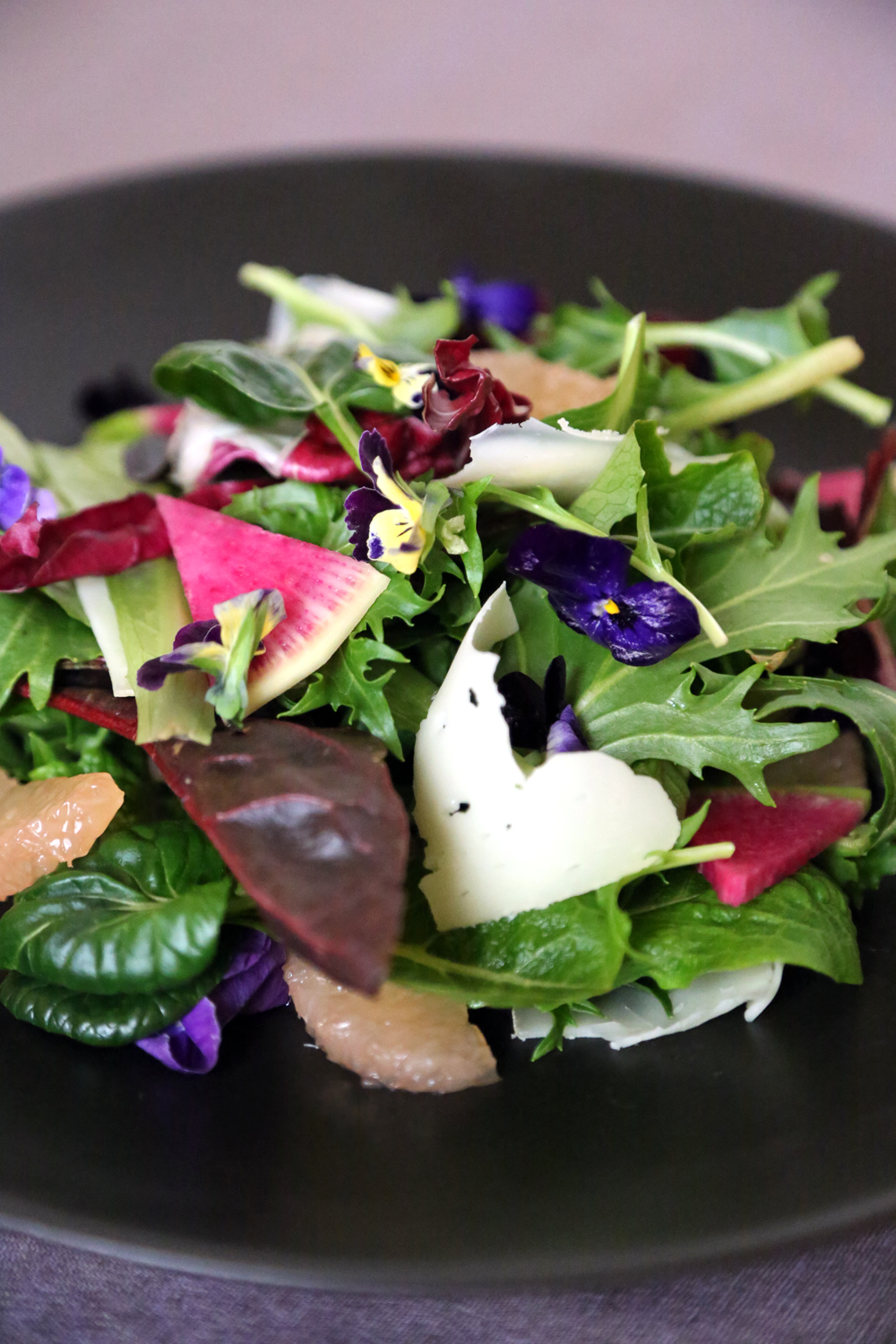
I must have been a rabbit in a former life because I just love fresh leafy salads! It is a real joy to wander around the garden and collect not just lettuce but the ever increasing salad herb selection which has become more popular and more available in recent years. These add flavour, crunch and colour to any salad, and a few leaves go a long, long way. Flavours on many such as Red Mustard are very acute and may be hot; so use sparingly. They are best added to lettuce which will create a subtle base for these enlivening flavorants. Many have their origins in Asia such as Chop Suey Greens (which is really Chrysanthemum coronarium). The Japanese use the leaves in tempura and the Chinese garnish soup with the petals from its pretty yellow and white/yellow two tone flowers. I use it in stir-frys along with Mizuna! Anyone can grow these edibles quite simply in the open ground, raised bed or window box. If growing in containers, mix soil with compost and granular fertilizer. To ensure a plentiful supply, liquid feed weekly. There are many good, organic liquid feeds on the market. Salads should be featured at some stage of a meal, either as an appetizer to stimulate the appetite or after the main course to cleanse the palate and settle the stomach. Of course here in Ireland the salad is more often a side accompaniment munched along with everything else!
If space is limited, use the cut and come lettuce varieties. My favourite is Red and Green Salad. Just harvest the leaves as you require them but do not massacre the plant. Interplant with a selection of choice Salad Herbs: most are available as plants or mixed seed packs. However, for a novice the latter can prove too daunting – plus you may not be able to identify the various individuals and flavours can be extremely distinctive. Most provide cutting for approximately six to eight weeks, so I recommend planting or sowing every few weeks. I like to grow in a location which gets half sun and half shade. Otherwise many bolt (go to seed) far too quickly as summer approaches. Everyone knows Rocket but the Wild variety is far superior – it has a strong, pungent flavour and has the added bonus of being a perennial (lasts for more than a year). If you get it to over-winter you will enjoy a continual harvest. Salad flowers are also trendy and fun, adding a touch of artistry to the dinner plate. Simple to grow; try Borage with its sky blue flowers, Chives with its pink ones and Old English Marigold and Nasturiums for the more brash reds and oranges.
Each year I try to grow and sample a few new varieties. This year it is Mizuna Red Knight with its colourful leaves, Tatsoi a ground-hugging member of the pak choi family and Mustard Greens Ruby Streaks which has attractive red serrated foliage but to my astonishment does not taste at all like a Mustard. And, as the children in Scoil Bhreac Chluain cheerfully exclaimed: “this tastes like potato” – and how right they are! Next year hopefully I will try the Snow Pea Plant (Pisum stivum), the tendrils and top few leaves are an important ingredient in Shanghai and Vietnamese cooking. They can of course also be added to Salads!
-
-

Locally grown Herb Plants Annascaul 
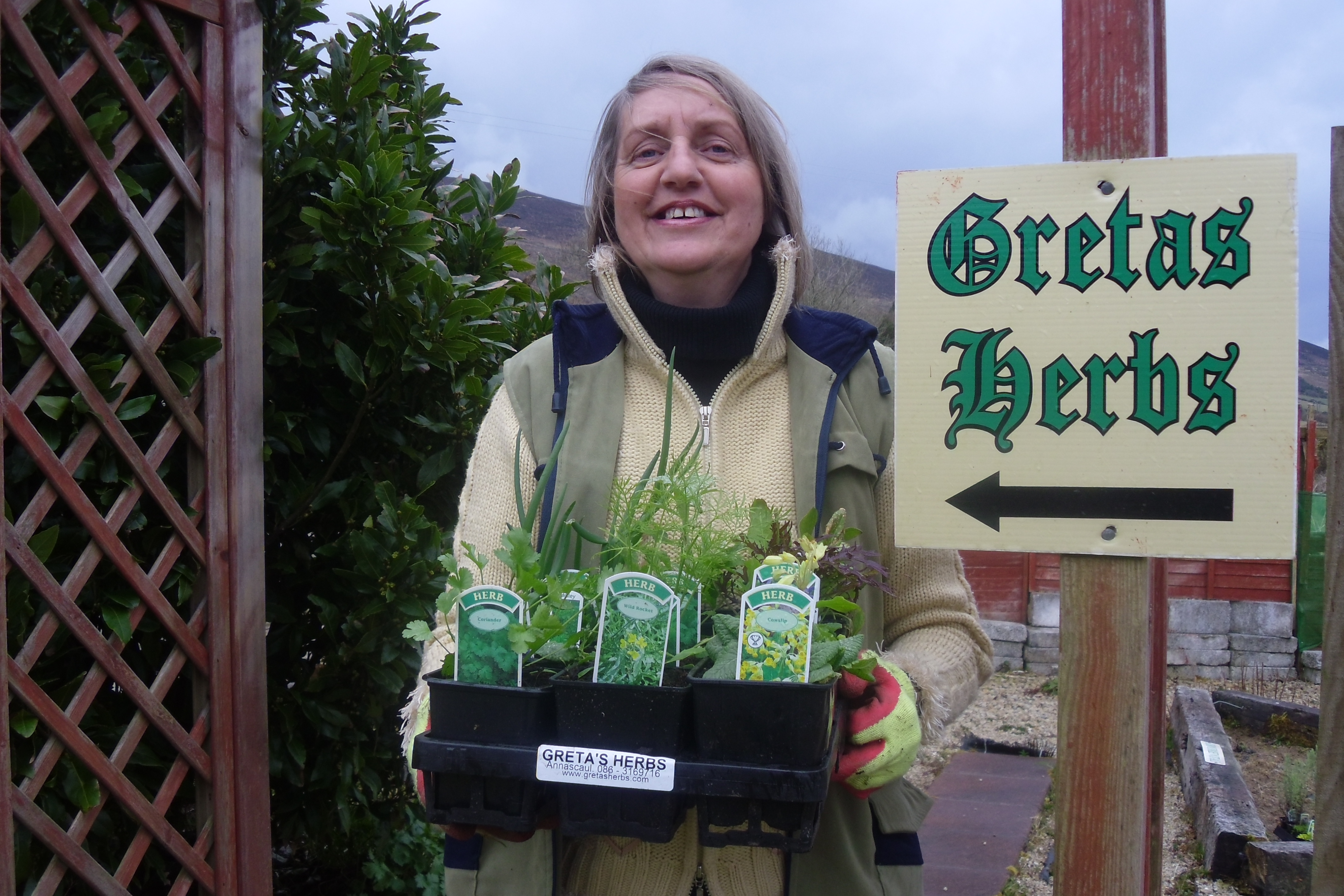
Greta’s Herbs with Greta McCarthy O Brien 
Attentive audience 
Lost in transplantation not translation! 
Seed Sowing Demo! -
Greta’s Herbs

Bitter, cold, dry weather conditions have made this spring of 2013 the hardest I can remember. The countryside is barren; the buds on my Horse Chestnut tree have yet to burst into that wonderful wave of green which in my garden marks the arrival of springtime. My seedlings in the polytunnel have to be nurtured like premature babies in an incubator. I have to cover them with fleece each night. Alas the few that escaped cover suffered severe frost bite recently. Most things will recover if allowed defrost gradually in early morning: keep them out of direct sunlight until later in the day so their cells don’t collapse.
I have moved out a lot of the hardier herbs and salad vegetables including Lettuce, Mizuna, Rocket and Parsley. Regardless of this intense cold, young plants will require watering. Aim to do this before late evening to avoid chilling! Once the temperature rises by about 5 degrees and the rain softens the atmosphere, we can commence planting in earnest. Any of my herb plants on sale inside – such as the local supermarket – will already have been hardened off so just leave them outside in their pots before planting.
I just planted the first batch of early potatoes last week but still have plenty more to plant. Everything is very late this year. My three tomato varieties have failed to emerge; the first time this has ever happened so I will have to make repeat sowings. Luckily I never sow all seeds at once so losses will be minimal.
I had the unsavory task of checking for any vine weevil larvae (Otiorhyndus sulcatus) which may have over-wintered in potted plants from last season. These small white grubs with bronze heads adore munching on roots of certain plants such as Primulas and some have even formed a taste for my Mint plants. They completely devour the plant’s root system and if not manually extracted cause awful damage. I avoided physically squashing them this year and choose instead to feed them to my goldfish in the pond. Lots of protein after a difficult winter will enhance their health! If the vine weevil larvae escape detection, they mature into nasty adult beetles which attack the foliage of many shrubs in summer, creating semi circular bites along the leaf edge. One way of identifying this brownish vandal is to knock it over and watch it play dead: it is a deceptive creature. One can invest in the organic, biological control by nematodes. These are microscopic pest parasites which are mixed with water and then applied to the soil. There are well over 100 species used to control a variety of insects and pests including slugs. It is an expensive but highly effective method however the weather condition, e.g. temperature must be correct to ensure success. I have never used them, possibly preferring to indulge in my own sweet revenge of elimination or better still biodiversity!





 Gretas Herbs Annascaul, Dingle, Co Kerry